Private-home prices rise 1.4% as new sales fall sharply
URA’s Q3 2026 figures show resales held steady. For HDB upgraders, the next step is matching a specific home to confirmed cash, CPF and borrowing capacity.
Published 25 October 2026
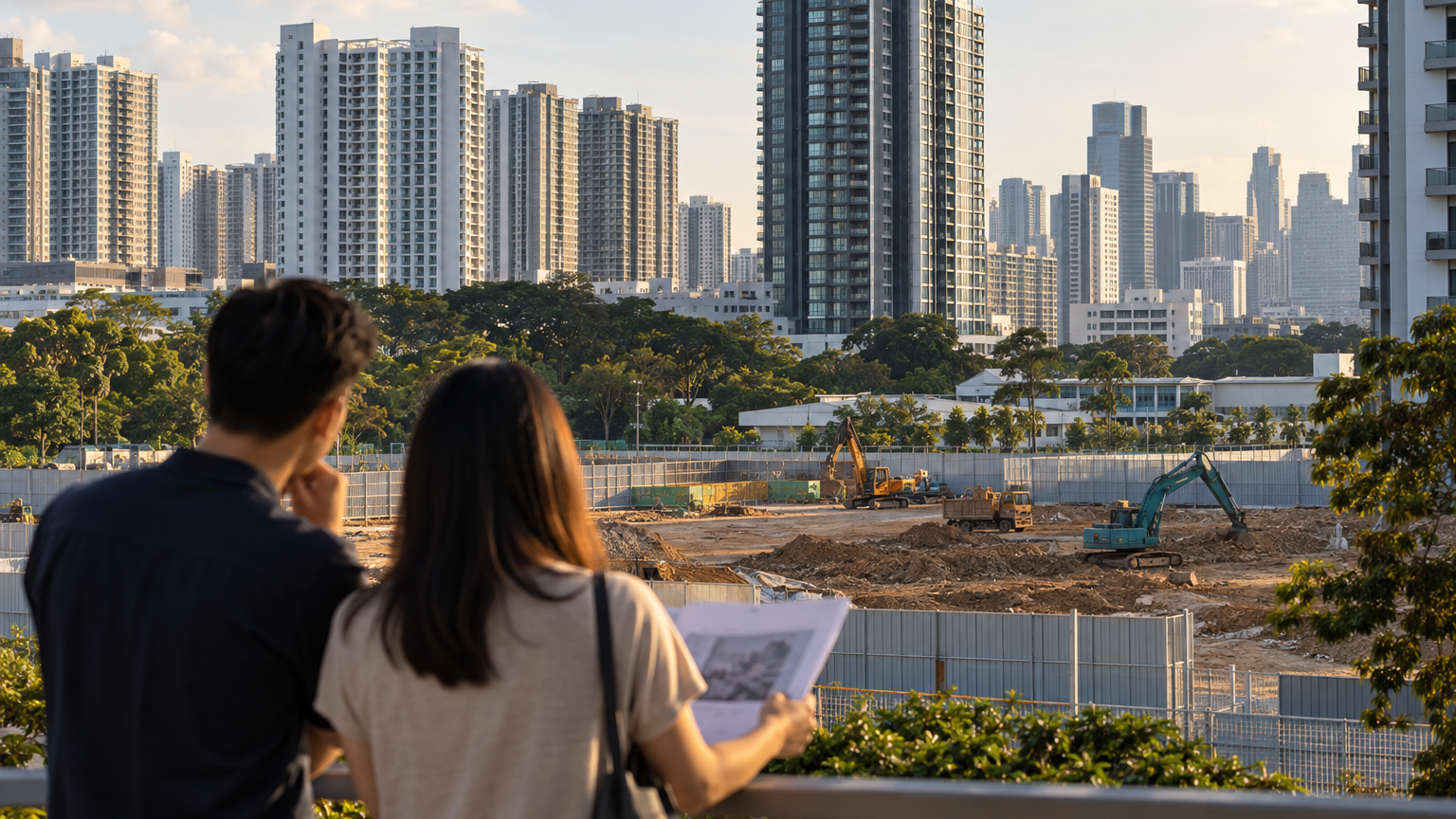
Singapore’s private-home prices rose 1.4% in the third quarter of 2026, even as developers sold substantially fewer new homes. The Urban Redevelopment Authority’s figures, released on 23 October, recorded 1,183 developer sales excluding executive condominiums, down from 2,141 in the preceding quarter.
For an HDB household considering a condo, that is an uncomfortable combination: fewer sales did not bring a lower overall price index. The practical question is whether the particular home you want still fits your sale proceeds, usable CPF savings and borrowing capacity—not simply whether more buyers will return next quarter.
Fewer new sales, but a different resale picture
Developer sales fell by approximately 45% quarter on quarter, calculated from URA’s figures. Developers also launched fewer uncompleted private homes: 1,140 excluding ECs, against 1,783 in the second quarter—a decline of about 36%. The slowdown in sales therefore came alongside a smaller flow of newly launched homes.
Private resales were much steadier. There were 3,801 resale transactions, compared with 3,813 in the previous quarter, and they accounted for 73.9% of all private-home sale transactions. That is roughly three out of every four transactions, making resale homes an important part of the quarter’s story rather than a sideshow to launches.
The overall price increase also hides differences between property categories and locations. Non-landed private-home prices rose 1.0%; within that category, prices in the Outside Central Region rose 2.3%, those in the Rest of Central Region were unchanged, and those in the Core Central Region rose 0.3%.
For an upgrader, the useful comparison is therefore between actual shortlisted homes. Applying the overall 1.4% increase to every condo would overlook the variation already visible in URA’s own breakdown.
Your flat’s sale price is not your next-home budget
A sensible starting point is an estimated breakdown of your HDB sale: the expected selling price, outstanding housing loan to redeem, CPF refund and resulting cash proceeds. Keep the cash and CPF amounts separate when planning the next purchase; a headline sale price is not a statement of how much cash will be available.
Next, establish how much CPF Ordinary Account savings you can actually use. CPF Board says this depends on factors including the property’s remaining lease, property type, loan type and whether it is a first or subsequent property purchase.
For a second or subsequent property, CPF Board also sets retirement-sum requirements before OA savings can be used, with housing limits applying. That makes the ownership position at the time of purchase relevant; do not assume that every dollar in the account is automatically available for the next home.
The useful output is two separate estimates: cash available for the purchase and CPF permitted for the purchase. Treat both as household-specific figures to confirm, rather than amounts that can be worked backwards from the private-home price index.
Check the loan before choosing the move sequence
Borrowing capacity is a separate calculation. The Monetary Authority of Singapore’s Total Debt Servicing Ratio framework limits total monthly debt repayments to 55% of monthly income. Its October 2026 parliamentary reply also states that banks assess housing loans using an interest rate of 4%.
In everyday terms, the assessment concerns your debts together, not just the instalment on the condo you are viewing. The framework also operates alongside loan-to-value limits, which constrain how much can be borrowed relative to the property’s value.
Ask a lender to assess the ownership and borrowing position you expect to have when purchasing. Then put that assessment beside your cash and CPF estimates. None of those figures alone establishes an affordable purchase price, and a planning estimate is not a loan approval.
For move planning, a useful next step is to map when each funding source is expected to be available against the proposed purchase payments. That turns “we can afford this eventually” into the more useful question: “Will the money be available when we need it?” Keep any unresolved funding gap visible before committing to a sequence.
More supply is coming; the next quarter remains open
URA estimated that about 32,800 private homes, including ECs, could be available for sale over the next one to two years. It also reported about 57,200 units expected to be completed in coming years. These describe different stages of supply and should not be added together as one pool of homes ready to buy.
That pipeline gives buyers more to watch, but it does not settle how quickly homes will sell or where prices will go. The third-quarter release records prices and transactions already observed; it does not establish a fourth-quarter recovery.
For an HDB upgrader, the clearest next development is personal rather than predictive: a confirmed funding picture for a specific shortlist. Establish the cash, check the CPF and obtain a lender’s assessment before letting the next launch set your timetable.
Sources
- How much CPF savings can I use for my property purchase? · CPF Board
- Oral reply to parliamentary question on the impact of sustained increases in US Treasury yields · Monetary Authority of Singapore
- Release of 3rd Quarter 2026 real estate statistics · Urban Redevelopment Authority