New private-home sales fell 45% in Q3, but prices kept rising
Fewer launches accompanied the sales drop. For HDB upgraders, the next calculation is the gap between usable sale proceeds and a fully funded purchase.
Published 24 October 2026
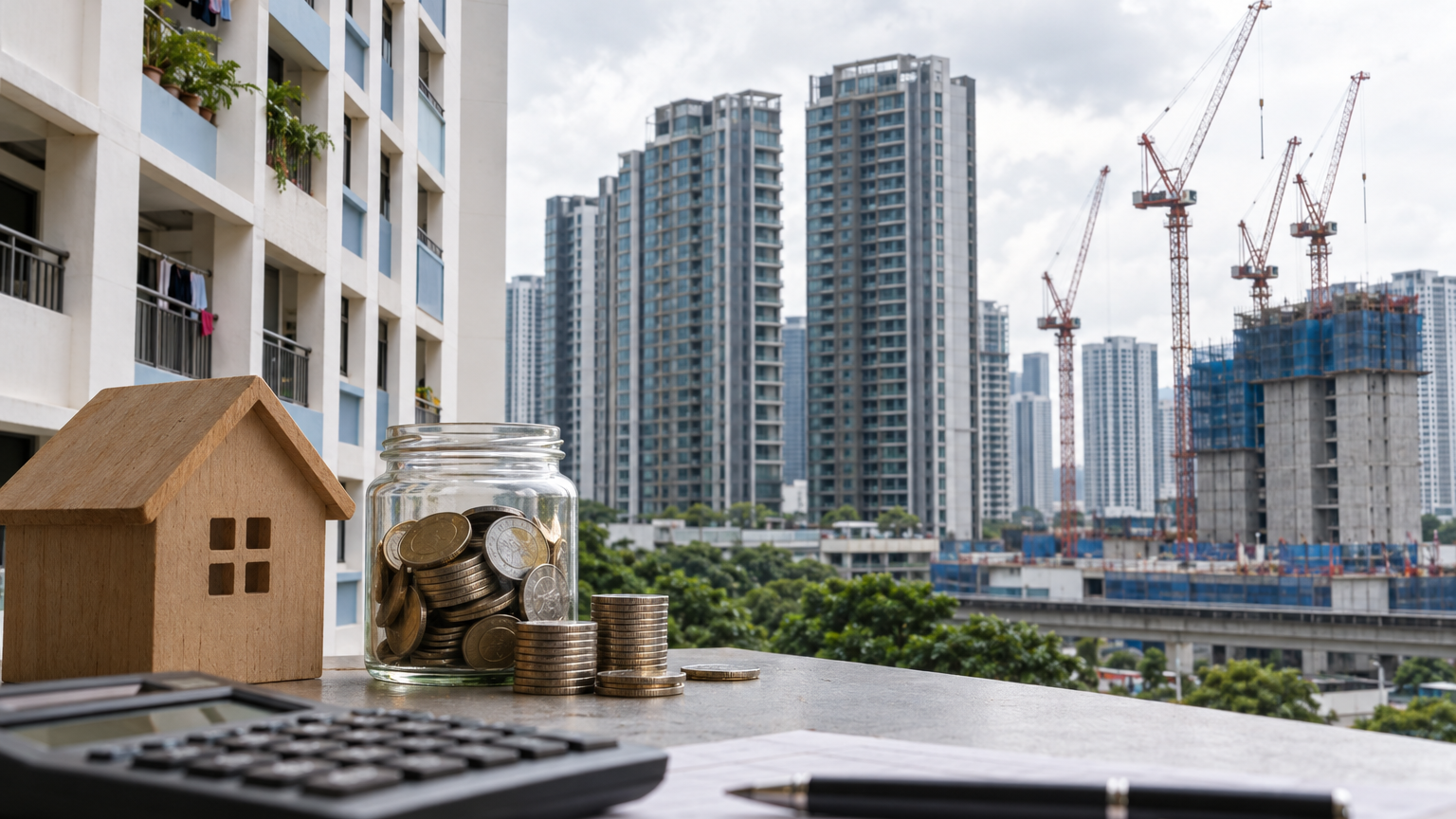
Developers sold 1,183 new private homes in Q3 2026, down from 2,141 in the previous quarter. Yet Singapore’s overall private residential property price index rose 1.4%, faster than its 0.5% increase in Q2, according to final figures released by the Urban Redevelopment Authority (URA) on 23 October.
For HDB owners considering an upgrade, the other half of the picture was just as important: HDB’s resale price index slipped 0.1%, while resale transactions climbed 19.5% to 7,645. The two markets moved differently, leaving households to work out the gap between what their flat might fetch and what their next home would cost.
Why fewer sales and higher prices can happen together
The developer-sales decline works out to 44.7%, calculated from the fall of 958 units between Q2 and Q3. But developers also launched fewer homes: 1,140 uncompleted private units, against 1,783 in Q2—a reduction of about 36.1%. Both sets of figures exclude executive condominiums, or ECs.
That launch comparison matters. Buyers were choosing from a different flow of newly released homes, so the sales decline should be read alongside the reduced launch activity, rather than treated on its own as a measure of buyer appetite. The figures establish that launches and sales both fell; they do not isolate how much each factor contributed to the result.
Nor are developer sales and the overall price index measuring the same thing. The former counts homes sold by developers; the latter tracks broader private residential price movements. Reading them together gives a fuller picture than expecting one number to move in step with the other.
There were differences within the price figures, too. Non-landed private-home prices rose 1.0% overall. Within that category, prices in the Outside Central Region rose 2.3%, while those in the Rest of Central Region were unchanged. An upgrader comparing suburban condominiums therefore has a more relevant reference than the headline figure alone, although neither index values a particular unit.
What happened on the HDB side of the move?
HDB resale activity picked up from 6,396 transactions in Q2 to 7,645 in Q3—an additional 1,249 transactions. At the same time, the resale price index recorded its third consecutive quarterly decline, falling 0.1%. More flats changed hands without an increase in the broad price measure.
For an upgrading household, this is useful background, not a sale-proceeds estimate. The HDB and private-home indices describe separate markets; subtracting one percentage change from the other would not tell a family how much more money it needs to move. The chosen flat and replacement home still need their own price assessments.
A more useful starting point is to put two actual properties side by side: the flat being sold and the home being considered. Ask for a realistic sale estimate for the former and establish the full purchase budget for the latter. Keep the working figures provisional until the relevant valuations, financing and transaction details are available.
This avoids a common budgeting shortcut: treating the expected selling price of the flat as the amount available for the next purchase. Instead, ask for a proceeds breakdown that separately identifies the outstanding housing loan, any CPF refund, transaction expenses and the cash expected to remain. The purpose is to distinguish money on paper from money available at the point it is needed.
Separate the cash requirement from the loan budget
CPF Board says a private-property buyer using a bank loan must first pay at least 5% in cash, based on the lower of the purchase price or valuation. CPF Ordinary Account savings can be used only after the stipulated cash payments and legal documentation requirements are met.
As a simple illustration, where both the purchase price and valuation are $1.5 million, 5% is $75,000. That is a calculation illustrating the minimum cash component described by CPF Board—not an estimate of the household’s entire down payment, purchase costs or approved financing.
The distinction is practical. A household should have separate lines in its working budget for cash and CPF savings, rather than combining everything into one reassuring total. It should also ask when each sum will be available relative to the purchase payments.
Borrowing has a separate limit. MAS says the Total Debt Servicing Ratio, which measures total monthly debt repayments against monthly income, is capped at 55%. Its cited parliamentary reply also says banks assess mortgage affordability using a 4% interest rate, even when prevailing rates are lower.
For illustration, 55% of a monthly income of $10,000 is $5,500. That amount covers total monthly debt obligations, not just the proposed home loan. It is not a promise that a bank will approve a mortgage with a $5,500 instalment; the lender must assess the household’s circumstances.
Put the sale and purchase on one calendar
The useful upgrade question is therefore not simply, “Can we afford this condo?” It is, “Can we fund each stage of this move when payment is due?”
Before committing, build a single timeline showing the expected flat-sale completion, loan redemption, availability of cash and CPF funds, purchase payments and handover of the next home. Ask the professionals handling the transactions to check the assumptions rather than relying on an informal sequence.
Then compare the two possible approaches. Selling first means planning where to live if the replacement home is not ready. Buying first means asking the lender and conveyancing lawyer to establish the funding and ownership implications before assuming that future sale proceeds can cover the purchase.
Keep eligibility separate from affordability, especially if an EC is among the options. URA reported no new EC launches in either Q2 or Q3, while developers sold 68 EC units in Q3, down from 175. Those sales are separate from the 1,183 private-home total, so they should not be blended into a single measure of available upgrade choices.
What remains unresolved for an upgrader
The Q3 releases answer what happened across the markets: fewer developer sales and launches, a higher private-home price index, and more HDB resale transactions alongside a slightly lower resale index. They do not settle the price or financing of a household’s next move.
The next useful step is a household-specific funding assessment: a realistic flat-sale estimate, a clear proceeds breakdown and a lender’s assessment of borrowing capacity. Only then can a family compare homes using a budget that separates cash, CPF and debt.
The clearest consequence of this quarter’s numbers is that a quieter new-home market did not come with a lower broad private-home price index. For an HDB upgrader, the deciding gap remains the one between the proceeds actually available and the cost of the particular home they want—not the gap between two headlines.
Sources
- Can I use my CPF savings for the down payment of my property? · CPF Board
- 3rd Quarter 2026 Public Housing Data and Upcoming Flat Supply · Housing & Development Board
- Oral reply to Parliamentary Question on the impact of sustained increases in US Treasury yields · Monetary Authority of Singapore
- Release of Q3 2026 real estate statistics · Urban Redevelopment Authority