HDB resale prices slip as private homes climb: recalculating the upgrade gap
Final Q3 2026 figures diverged. For HDB owners eyeing a condo, the next calculation separates sale proceeds, CPF refunds and the cash needed to buy.
Published 24 October 2026
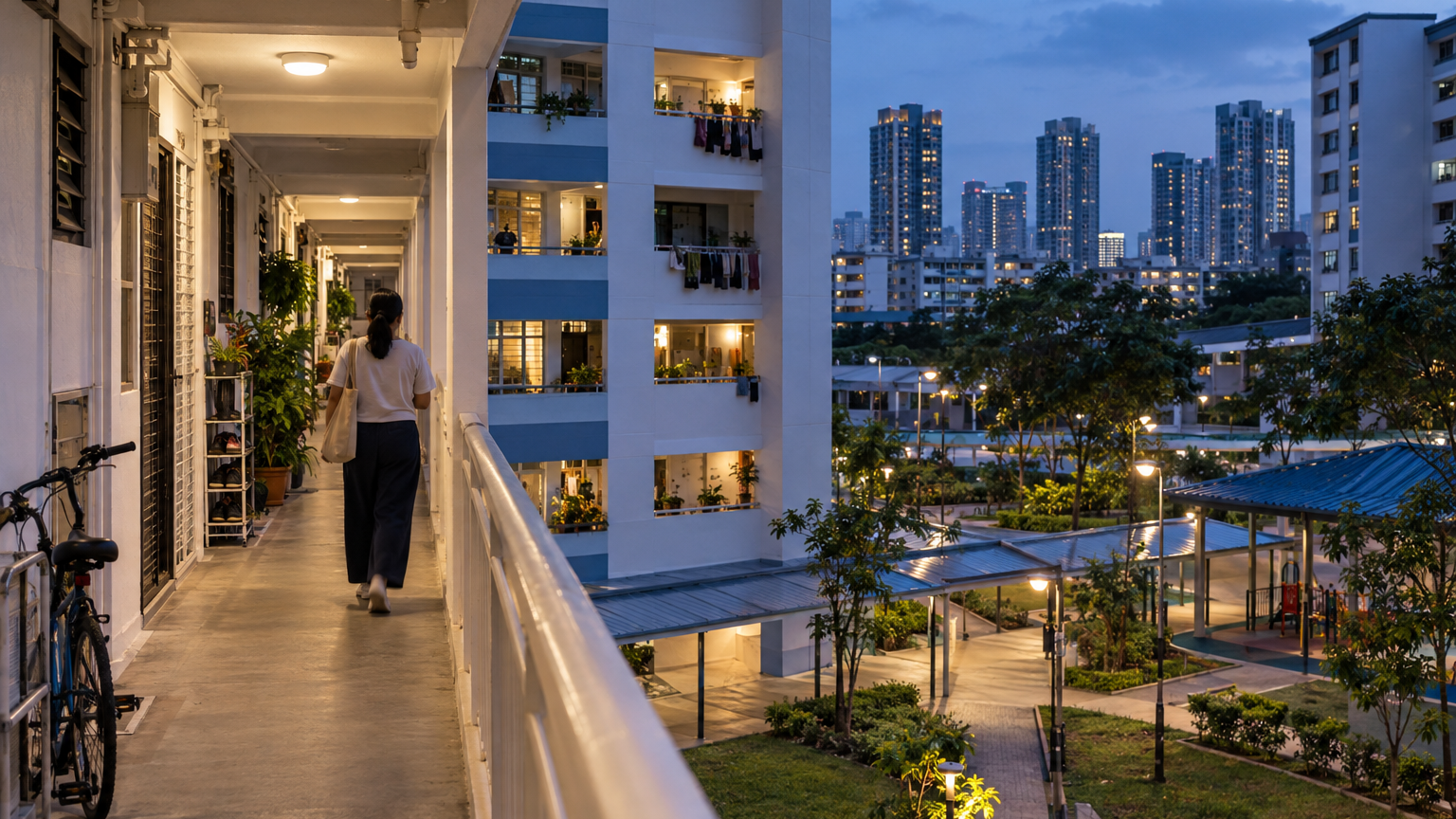
HDB resale prices edged down 0.1% in the third quarter of 2026, while private residential prices rose 1.4%. The final figures put the two broad markets on opposite paths over the same three months—an uncomfortable combination for households hoping to sell a flat and buy a private home.
For those households, the useful question is how much money must bridge the two purchases. That starts with a distinction that can get lost while browsing listings: your flat’s selling price is not your available cash budget. The outstanding housing loan and required CPF refund must be accounted for before working out what remains from the sale.
What changed—and which private homes rose fastest?
URA’s final statistics, released on 23 October 2026, showed that private residential price growth accelerated from 0.5% in Q2 to 1.4% in Q3. HDB’s final resale figure was a smaller decline than the preliminary estimate of 0.2%. The final 0.1% fall is the figure to use when comparing the quarter.
The private-market headline also bundles together different types of property. Landed prices rose 2.9%, while non-landed prices—which are more relevant to a condominium search—rose 1.0%. Within the non-landed market, prices in the Outside Central Region rose 2.3%, while those in the Rest of Central Region were unchanged.
That gives a more useful comparison than treating every condo as though its price rose 1.4%. An upgrader looking outside the central areas was searching within a segment whose index increased faster than the overall non-landed measure during the quarter.
Subtracting the HDB change from the overall private-home change gives a 1.5-percentage-point difference in quarterly movements. That is a calculation from the two indices, not a 1.5% increase in the dollar amount needed to upgrade: the indices measure separate markets, rather than the prices of the particular homes a household would sell and buy.
The practical response is to refresh both sides of the budget together. Updating the expected condo price while leaving an old flat-sale estimate untouched—or doing the reverse—would make the comparison less useful.
Start with what the flat sale actually releases
Before choosing a purchase budget, separate the flat’s likely sale proceeds into money needed to settle the loan, money refunded to CPF, and any cash remaining. CPF’s upgrade guidance says the outstanding housing loan and required CPF housing refund must be addressed from the sale proceeds.
The CPF refund is particularly important because it is not simply the original amount withdrawn. The required refund generally includes CPF savings used for the property and the accrued interest those savings would have earned. Your own CPF housing records, rather than a rough memory of the down payment, are the starting point for that calculation.
For members below 55, refunded housing monies generally return to the Ordinary Account, or OA, and may be available for another home subject to CPF housing rules. That means the refund need not disappear from the upgrade plan, but it belongs in a different column from cash in the bank.
A useful planning sheet therefore has separate lines for the outstanding mortgage, required CPF refund, estimated cash proceeds and potentially reusable OA savings. Keep transaction expenses separately visible too, rather than treating every dollar left after the mortgage as spending money.
This is a planning exercise, not a valuation. Use an estimated selling price until a sale is agreed, and label the result accordingly. The aim is to see what the move depends on before making a commitment—not to turn an optimistic asking price into an assumed source of funds.
Check the cash requirement before adding everything together
The next home brings a different financing arrangement. CPF’s guidance states that private-property and executive-condominium purchases use bank loans rather than HDB loans. An existing HDB loan therefore should not be treated as a template for financing the next purchase.
CPF also states that a private-property buyer must pay at least 5% in cash of the lower of the purchase price or valuation before using OA savings for the down payment. The actual financing outcome remains subject to applicable lending rules and lender approval.
Here is a simple illustration of that minimum alone: if both the purchase price and valuation were $1.5 million, 5% would be $75,000. This is arithmetic, not a suggested purchase budget or a statement that $75,000 is the total cash needed to complete such a purchase.
The distinction matters when much of a household’s housing wealth sits in CPF. A combined total of cash and OA savings may look reassuring, but the cash portion still needs to meet the applicable cash requirement. OA savings cannot simply replace that required payment.
Before narrowing a search to a particular price range, ask the bank to assess borrowing capacity and explain the cash contribution required for the intended purchase. Keep an indicative assessment separate from final approval. The budget should be built around the financing available to your household, not a loan amount assumed from a listing price.
Put the money on a timeline
Once the amounts are clearer, map the sequence. For planning purposes, write down when you expect the flat sale to complete, when you expect its cash proceeds and CPF refund to be available, and when payments for the next home would be needed. Confirm those dates with the parties handling the transactions rather than assuming everything lines up.
The reason for separating the dates is straightforward: sale-related CPF refunds and cash proceeds are distinct funding sources, and private-home purchases have a required cash component. A plan needs to account for both the form of the money and when it can be used.
If the intended purchase relies on proceeds from the flat sale, make that dependency explicit before committing. Ask what happens if the expected sale price is lower or the transactions do not complete in the hoped-for order. Those are questions for the financing and conveyancing discussions, not gaps to fill with an assumed future price increase.
Rather than inventing a second household budget, try changing one input in your own worksheet: lower the estimated flat-sale proceeds, or raise the intended purchase price. The useful result is the amount of extra cash or borrowing the change would require. It shows where your plan has room and where it becomes tight.
The number to settle before the next viewing
The Q3 figures provide a reason to revisit an upgrade budget: HDB’s resale index slipped while private-home prices rose, with sizeable differences within the private market itself. They provide the backdrop, not a price quote for either home.
For an upgrader, the next useful milestone is a funding plan that reconciles cash, usable CPF savings, bank borrowing and payment dates. CPF’s guidance makes the central distinction clear: selling a home can release both cash and refunded CPF savings, while the next purchase has its own cash and financing requirements.
Settle that gap before treating a viewing shortlist as a purchase shortlist. The important number is not the difference between two national indices—it is the amount your household still needs to fund the move.
Sources
- Can I use my CPF savings for the down payment of my property? · CPF Board
- How much do I need to refund to my CPF account if I am selling my whole property? · CPF Board
- What to know before you upgrade to a new home · CPF Board
- Flash estimate of third-quarter 2026 Resale Price Index and upcoming flat supply · Housing & Development Board
- Resale statistics · Housing & Development Board
- Final third-quarter 2026 private residential property statistics · Urban Redevelopment Authority