Boon Keng Five-Room HDB Resale Sets $1.64 Million Record
The City View @ Boon Keng deal beat the previous Kallang/Whampoa high by $51,112—but an upgrader’s usable proceeds require a different calculation.
Published 17 October 2026
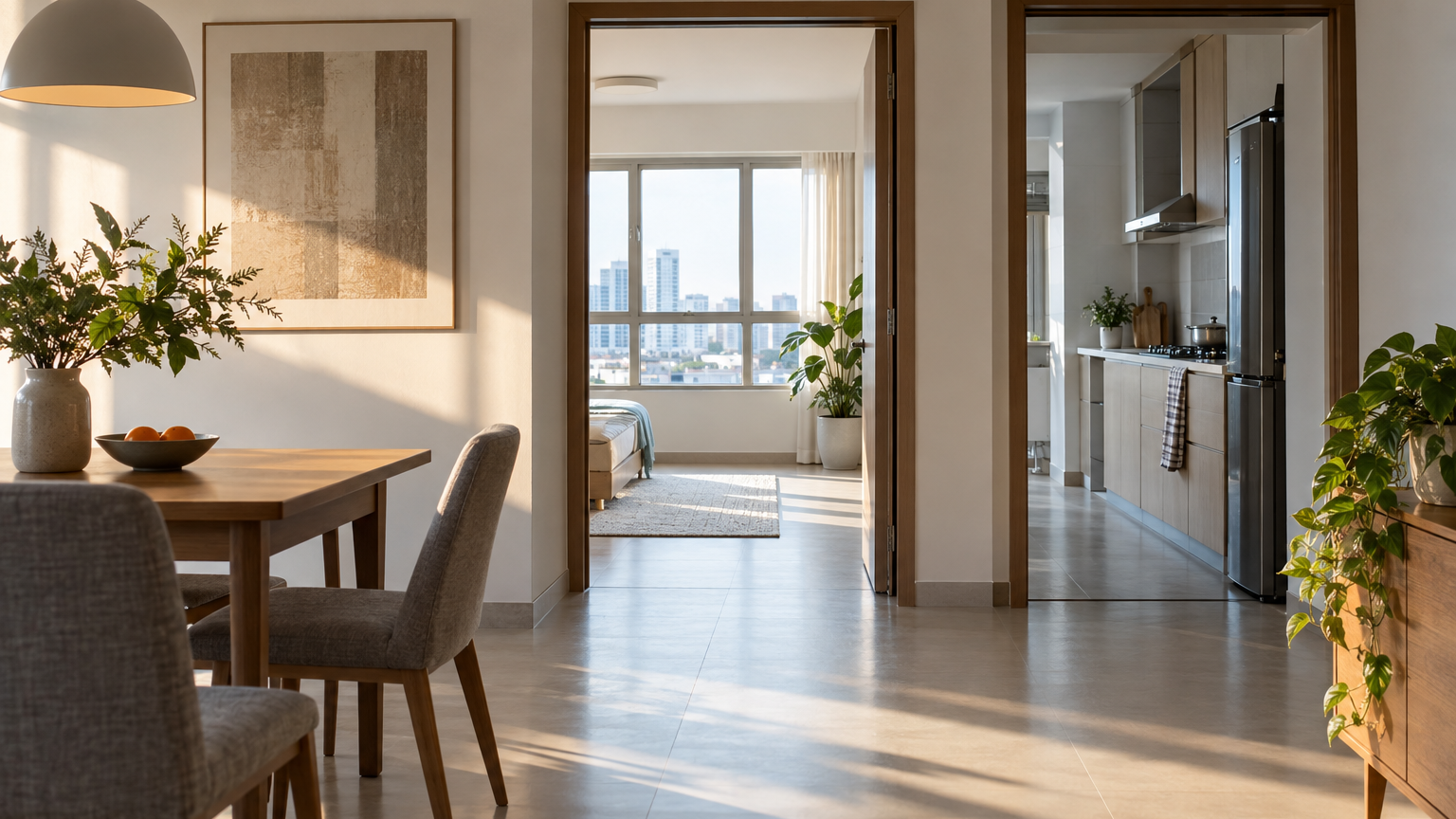
A five-room flat at City View @ Boon Keng changed hands for $1.64 million on October 15, 2026, setting a new five-room resale record for Kallang/Whampoa. The 117 sq m unit at Block 9 Boon Keng Road sits between the 34th and 36th storeys.
That price was $51,112 higher than the previous record, set just one month earlier. For HDB owners considering an upgrade, however, the more useful lesson is not that every nearby flat is suddenly worth a similar amount. It is that even a headline-grabbing sale price must be broken down before it becomes a workable next-home budget.
What exactly sold for $1.64 million?
The flat is part of City View @ Boon Keng, a Design, Build and Sell Scheme development. DBSS projects were built by private developers, but their units remain HDB flats and are subject to HDB ownership and resale rules.
The record unit measures 117 sq m, or about 1,259 sq ft, and its lease commenced in 2011. Its transacted price works out to a reported $1,302 per sq ft, also a five-room record for Kallang/Whampoa.
The previous high was $1,588,888 for a 116 sq m five-room Premium Apartment at Block 8A Upper Boon Keng Road in Kallang Trivista. That transaction was registered in September 2026.
Subtracting the two prices gives the $51,112 jump. But these were different flats in different developments, so the newer transaction should not be treated as an automatic valuation for another City View unit—or for five-room flats across Boon Keng.
There is also a timing limitation. The official public HDB resale dataset available during research did not yet include this October 2026 transaction, so the deal details come from independently reported HDB-derived transaction records rather than the downloadable official table.
A sale price is not the seller’s upgrade fund
It is easy to see $1.64 million and imagine a similarly large sum available for the next purchase. That is not how the money moves.
When a home is sold, the proceeds must first cover the outstanding housing loan. CPF savings used for the property—including the principal withdrawn and the accrued interest that money would otherwise have earned—generally have to be refunded to the owner’s CPF account.
A simplified planning calculation is:
Sale price − outstanding loan − required CPF refund − sale-related costs = residual cash
The CPF refund is not lost. Money returned to the Ordinary Account may be available to support another home purchase, subject to the CPF housing rules that apply to the owner and the next property. But it is not the same as cash in a bank account, and owners should keep the two amounts separate when working out their deposit and renovation buffer.
Consider two owners who sell identical flats at the same price. One may have a larger unpaid mortgage; the other may have used substantially more CPF over the years. Their eventual cash proceeds could therefore look very different even though the headline transaction prices are identical.
That is why an upgrader’s first useful number is not a neighbour’s record sale. It is the household’s own estimated net proceeds, based on the outstanding loan, CPF property details and likely selling costs.
Check the next-home financing before committing
The next step depends on what the household intends to buy. Someone moving to another HDB resale flat should obtain an HDB Flat Eligibility, or HFE, letter before committing to the purchase. It provides upfront information on eligibility, applicable CPF housing grants and eligibility for an HDB housing loan.
For an eligible resale purchase financed with an HDB loan, the stated loan ceiling is up to 75% of the lower of the purchase price or HDB valuation, subject to the applicable conditions. This distinction matters when a buyer agrees to pay more than the valuation: the price gap does not simply increase the HDB loan available.
A bank loan is assessed under the financial institution’s own terms. Whether the next home is another HDB flat, an executive condominium or a private condominium, borrowing capacity, CPF usage and the cash required will depend on the household and property. None of those outcomes can be derived from the unknown buyer’s or seller’s finances in this record deal.
Owners buying another HDB resale flat may also be able to request HDB’s Enhanced Contra Facility. If eligible, it coordinates the sale and purchase so cash proceeds and refunded CPF savings from the existing flat can be used for the next resale flat. It applies to an HDB-to-HDB resale move, not an upgrade into private housing.
The sequence matters as much as the price
Before shopping seriously, an upgrader can map the move in four stages: estimate net sale proceeds, confirm the next property’s financing route, allow for the timing of CPF refunds and completion, then retain a buffer for purchase costs and the move itself.
This avoids a common mismatch—choosing the next home based on a gross sale estimate before checking how much will actually return as cash, how much will sit in CPF and when those funds become available.
The Boon Keng transaction is remarkable because a specific high-floor, five-room DBSS flat reached $1.64 million, beating a month-old town record. For another owner, though, the number that determines whether an upgrade works will be far more personal: what remains after the loan, CPF refund and costs, matched against financing that has actually been assessed.
Sources
- What to know before you upgrade to a new home · Central Provident Fund Board
- Five-room flat at Boon Keng sets new town record of $1.64 mil · EdgeProp Singapore
- Mode of Financing for a Resale Flat · Housing & Development Board
- Request for Enhanced Contra Facility · Housing & Development Board
- Resale flat prices based on registration date from Jan-2017 onwards · Singapore Government Developer Portal